01 · THE OPPORTUNITY
Why do smart people with good ideas build things nobody uses?
AI has made it easier than ever to build impressive prototypes. But building something technically impressive is not the same as creating something people need, trust, adopt, and use.
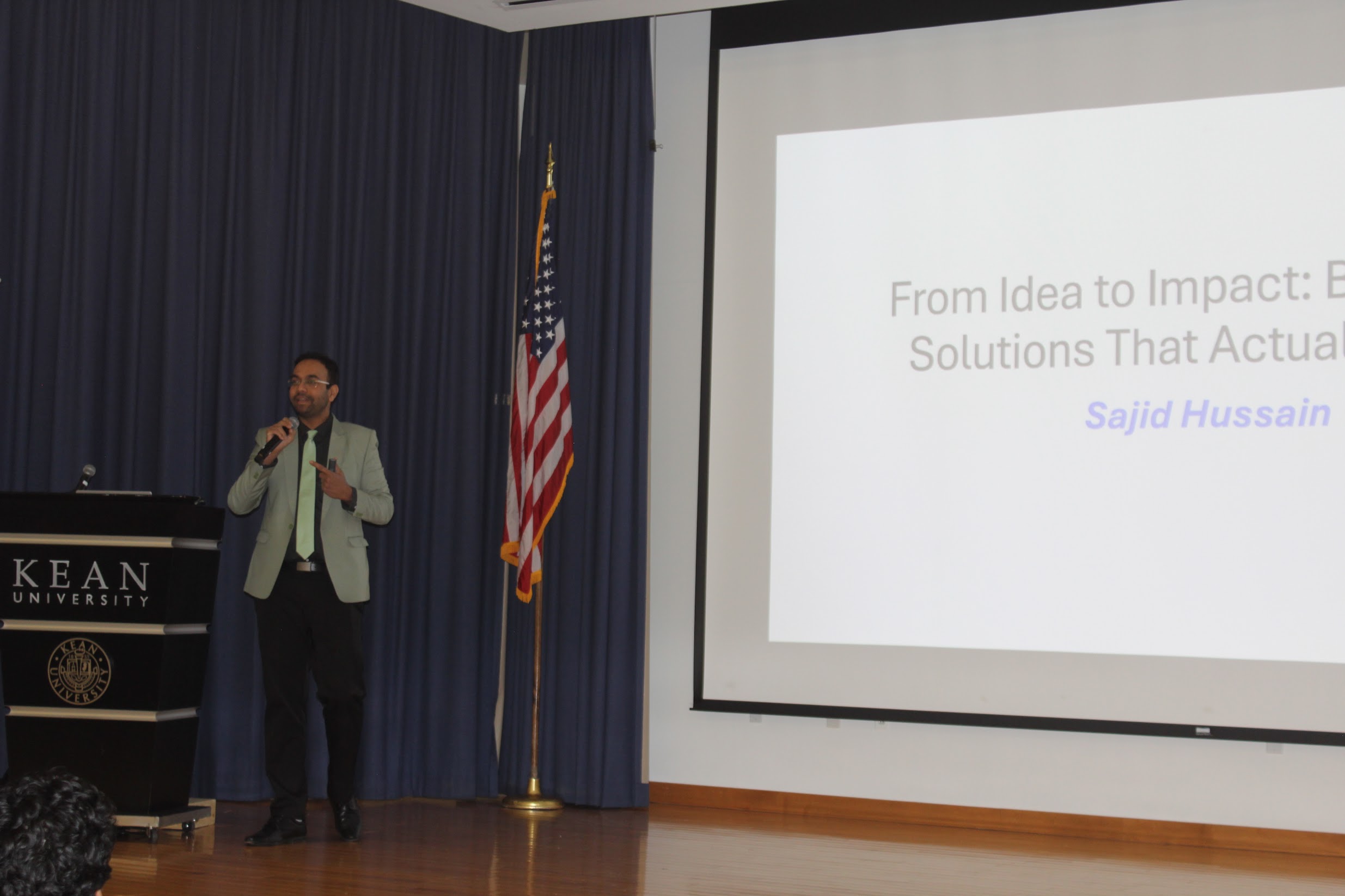
The “IDea to Impact” workshop at Kean University explored the gap between an AI idea and a solution that creates measurable value.
The central question was simple: How do we move from “This is a cool AI idea” to “This solves a real problem”?
The best AI solutions do not start with the fanciest model. They start with a real problem, a specific user, and a clear definition of value.
02 · AI CREATES VALUE
A simple lens for evaluating AI use cases.
We explored four fundamental ways AI can create business and organizational value.
Cost
Perform the same work cheaper or faster by reducing manual effort, processing time, or operational overhead.
Revenue
Sell more, improve conversion, increase productivity, or create opportunities for better margins.
Experience
Improve customer and employee journeys through better personalization, responsiveness, and access to information.
Capability Shift
Augment people and enable new capabilities rather than simply thinking about AI as a replacement for human work.
AI creates value when it improves a key metric in a measurable, repeatable way on a decision or workflow.
03 · AI IN PRACTICE
From AI capabilities to real-world applications.
Healthcare provided a useful lens for discussing where AI can create value — and why deployment requires much more than a working model.
Clinical Decision Support
AI systems can analyze clinical information to support clinicians in decision-making and information retrieval.
Drug Discovery
AI can accelerate the exploration and prioritization of potential drug candidates.
Patient Monitoring
Intelligent systems can continuously analyze signals and surface patterns that may require attention.
Administrative Automation
AI can support scheduling, documentation, billing, and other repetitive operational workflows.
Personalized Care
Data-driven systems can support more individualized care decisions based on relevant patient information.
Clinical Workflows
Automation can reduce repetitive administrative work and allow clinicians to spend more time on higher-value tasks.
04 · PRODUCTION THINKING
A chatbot can work perfectly and still be a bad system.
One example explored what happens when an AI chatbot is designed without considering concurrency, conversation state, latency, token usage, and cost.
A production AI engineer has to ask: What happens when the user behaves in a way I didn't expect?
This is the difference between a demo and a system that could actually ship. Production systems have to account for real users, slow networks, malformed inputs, concurrency, unexpected behavior, cost, reliability, security, and malicious intent.
05 · AGENTIC AI
Should your business use Agentic AI?
The question is not whether agents are exciting. The question is whether an agent is the right tool for a specific workflow.
We examined why successful automation initiatives generally begin with a narrow, repetitive, high-volume process rather than trying to automate everything at once.
Pick one workflow
Identify a narrow process with clear inputs, predictable outcomes, meaningful volume, and measurable performance.
Establish a baseline
Measure the current process before introducing AI so the improvement can actually be demonstrated.
Test failure modes
Determine what happens when the system encounters ambiguity, missing information, unexpected inputs, or edge cases.
Expand deliberately
Scale only after the first workflow demonstrates reliable value and the operational model is understood.
The lesson: don't automate everything. Pick one boring, repetitive, high-volume process and prove that AI can make it meaningfully better.
06 · PRODUCT THINKING
The technology is rarely the whole value proposition.
A recurring problem with AI projects is building something technically sophisticated that nobody needs, trusts, or adopts.
We looked at examples such as healthcare tools patients did not trust, enterprise systems that did not fit existing workflows, and technically impressive products that failed to retain users.
Clear Problem Statement
What specific user wastes time or money doing what painful process today?
Specific User
Who exactly is the user? What is their context, workflow, constraint, and current behavior?
Value Proposition
Instead of the old way, what can the user do now — and what measurable outcome does that create?
Success Metric
What metric will prove that the solution actually works?
07 · DIFFERENTIATION
“Why build this when ChatGPT exists?”
Every AI product needs a compelling answer to this question.
Saying “ours is better,” “ours is specialized,” or “ours uses RAG” does not explain why a customer should care.
Domain Data
The system uses proprietary or domain-specific information that a general-purpose model does not have access to.
Workflow Integration
The solution is embedded directly into the workflow rather than requiring users to copy and paste information between systems.
Compliance & Security
The architecture addresses the organization's security, privacy, compliance, and governance requirements.
Non-Technical UX
The product makes AI useful without requiring users to understand models, prompts, embeddings, or retrieval systems.
08 · DEMO & STORYTELLING
Nobody cares how complicated the technology is if you cannot explain why it matters.
A strong AI project needs more than a technical architecture. It needs a clear narrative that connects the problem, solution, evidence, and impact.
“Nurses waste 2 hours a day triaging patient messages. Our AI reduces that workflow to 30 seconds.”
That story communicates a problem, a user, a measurable outcome, and a reason to care — before discussing the underlying technology.
Problem
State the pain in one sentence and quantify it whenever possible.
Working Demo
Show the system working smoothly against realistic inputs.
Business Viability
Explain why the solution could become a sustainable product or workflow improvement.
Storytelling
Build a simple narrative: problem → solution → evidence → impact.
09 · IMPLEMENTATION ROADMAP
From assessment to scale.
Turning an AI idea into an organizational capability requires a deliberate implementation path.
Identify high-value workflows, current pain points, constraints, stakeholders, data, and measurable opportunities.
Define the architecture, users, success metrics, governance, security requirements, and implementation strategy.
Start with a narrow use case and validate the solution with real users and realistic conditions.
Expand only after the system demonstrates reliable value, operational readiness, and measurable outcomes.
10 · MEASURING SUCCESS
If you cannot measure the improvement, you have not demonstrated the impact.
Success metrics should be defined before scaling an AI solution. Depending on the use case, metrics can include:
Time
How much faster is the workflow?
Cost
How much operational cost is reduced?
Quality
Does the system improve accuracy or consistency?
Adoption
Are people actually using the system?
Reliability
Does it continue to work under realistic conditions?
Business Impact
Does the solution improve the metric that actually matters?
11 · THE PRODUCTION MINDSET
What happens when 1,000 people use it tomorrow?
The best AI systems are not necessarily the ones with the most sophisticated models. They are the ones where someone thought carefully about how the system could fail — and fixed those failure modes before users encountered them.
Production thinking means considering real users with unusual names, slow internet connections, malformed inputs, unexpected behavior, high traffic, rising API costs, security threats, latency, and malicious intent.
Before writing a single line of code, ask: “If 1,000 people used this tomorrow, what would catch on fire first?”
12 · KEY TAKEAWAYS
The principles I wanted participants to leave with.
Start with the problem. Technology should serve a clearly defined user need.
Define value. Know whether the opportunity is about cost, revenue, experience, or a capability shift.
Start narrow. Prove an AI workflow on one specific, high-value use case before attempting to scale.
Differentiate on value. Domain data, workflow integration, compliance, security, and UX can matter more than model sophistication.
Measure the outcome. A successful AI system improves a meaningful metric in a measurable and repeatable way.
Think about failure before launch. Production readiness means anticipating how real users and real systems will behave.
13 · MY PERSPECTIVE
AI leadership is about connecting technology to impact.
I believe the most important AI skill is not knowing which model to use. It is knowing where AI should be used — and where it should not.
Building AI systems requires technical depth. Creating impact requires a broader perspective: understanding users, workflows, business value, product design, risk, infrastructure, evaluation, and adoption.
My approach is to bridge those worlds — taking emerging AI capabilities and translating them into systems that are useful, measurable, reliable, and responsible.
“Nobody cares how it works. They care that it works — and why it matters.”
That is the mindset behind From Idea to Impact: move beyond AI demos and start thinking like the person who has to make the system actually work in the real world.
CONTINUE EXPLORING
Explore the work behind the conversation.
The workshop connects directly to my broader work across AI engineering, generative AI, agentic systems, education, and production AI.